Master the Math: A Step-by-Step Guide to Reconstituting Peptides
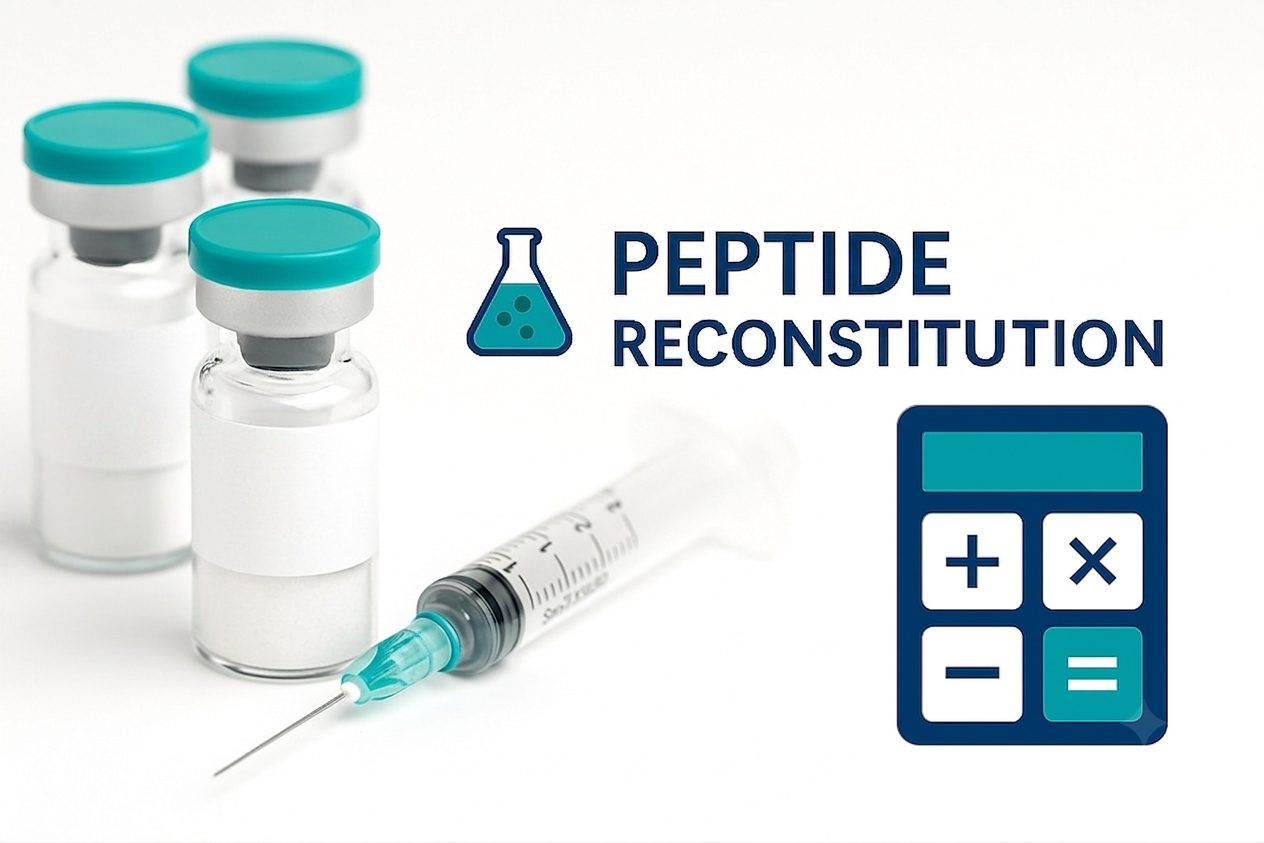
In this post we will tackle one of the most critical practical skills in peptide therapy: reconstitution.
When you purchase therapeutic peptides, they almost always arrive as a freeze-dried, stable powder (lyophilized cake) inside a sterile vial. To use them, you must precisely mix them with a liquid—usually Bacteriostatic (BAC) water—to turn them into an injectable solution.
Get the math wrong, and your dosing will be completely off. Get the protocol wrong, and you risk damaging these delicate amino acid chains.
Here is the definitive, step-by-step guide to reconstituting peptides safely, sterilely, and with absolute mathematical precision.
1. The Essential Gear
Before you start, ensure your workspace is immaculate. Clean a hard surface down with isopropyl alcohol and gather the following supplies:
Your peptide vial (still in powder form).
Bacteriostatic (BAC) Water: This contains 0.9% benzyl alcohol, which prevents bacterial growth. Do not use standard sterile water unless it’s for a single, immediate dose.
Alcohol prep pads: For sterilizing vial tops.
A reconstitution syringe: Usually a larger 3mL or 5mL syringe with a 21G to 25G needle to transfer the BAC water.
Insulin syringes: Typically 1mL (100 units) or 0.5mL (50 units) with a 31G needle for final administration.
2. Decoding the Reconstitution Math
The biggest hurdle for beginners is understanding the relationship between the milligrams (mg) of the peptide, the milliliters (mL) of BAC water, and the units on an insulin syringe.
The Golden Rule: Reconstitution doesn’t change the amount of peptide in the vial; it only changes how concentrated it is.
To find your dose, you need this simple formula:
Concentration (mg/mL) = Total Peptide (mg) / Total BAC Water (mL)
Once you know the concentration, you can calculate your specific dose volume. Since 1 mL = 100 units on a standard insulin syringe, the math breaks down cleanly.
Real-World Example: The 5 mg Vial
Let’s say you have a 5 mg vial of a peptide, and your target dose is 250mcg (0.25mg).
• If you add 2mL of BAC water:
5 mg / 2 mL = 2.5 mg/mL
• Convert to micrograms:
2.5 mg = 2500 mcg per mL
• Because an insulin syringe has 100 units per mL, divide by 100:
2500 mcg / 100 units = 25 mcg per unit
• To get your 250 mcg dose, you need exactly 10 units on the syringe.
Quick Reference Table
Here is how 2mL of BAC water alters unit measurements across common vial sizes:
| Total Peptide in Vial | BAC Water Added | Concentration per mL | Dosage per 1 Unit on Syringe |
| 2 mg | 2 mL | 1 mg (1000 mcg) | 10 mcg |
| 5 mg | 2 mL | 2.5 mg (2500 mcg) | 25 mcg |
| 10 mg | 2 mL | 5 mg (5000 mcg) | 50 mcg |
3. The Step-by-Step Mixing Protocol
Peptides are notoriously fragile. Rough handling can break the peptide bonds, rendering the compound completely useless. Follow these steps to ensure structural integrity:
Step 1: Prep and Sanitize
Wash your hands thoroughly. Pop the plastic caps off both the peptide vial and the BAC water. Wipe the rubber stoppers of both vials vigorously with an alcohol prep pad and let them air dry for 30 seconds.
Step 2: Draw the BAC Water
Using your larger reconstitution syringe, draw up the exact amount of BAC water you decided on (e.g., 2mL).
Tip: Pull back the plunger to inject an equal volume of air into the BAC water vial first; this equalizes the pressure and makes drawing the liquid much easier.
Step 3: The “Slow Drip” Injection
Insert the needle into the peptide vial at a 45-degree angle. Aim the tip of the needle against the glass wall of the vial, not directly at the powder cake.
Slowly depress the plunger. Let the BAC water trickle down the side of the glass. The vacuum in the vial may try to pull the plunger down rapidly—hold it back firmly to control the speed.
Step 4: Swirl, Never Shake
Remove the syringe. If the powder doesn’t dissolve instantly, do not shake the vial. Shaking creates foam and shears the delicate peptide molecules. Instead, gently roll the vial between the palms of your hands or swirl it slowly on a flat surface until the solution is completely clear.
4. Proper Storage & Longevity
Once reconstituted, the clock starts ticking. Peptides are highly susceptible to heat, light, and kinetic degradation.
Refrigerate Immediately: Store your mixed peptides in the refrigerator at 36 to 46°F. Do not freeze them once mixed.
Protect from Light: Keep them in a dark corner of the fridge or inside an opaque container.
Handle with Care: Avoid dropping or violently agitating the vial when retrieving it for your daily protocols. Most reconstituted peptides maintain peak potency for about 30 to 45 days when stored correctly.
Next Up in Our Series
Now that you know how to safely prep your solutions, our next deep-dive will cover advanced dosing scheduling, half-lives, and peptide saturation points. Drop your questions in the comments below!
Share The Beauty… Earn Rewards!
At PLEIJ Salon+Spa, we offer a simple and easy referral program to our existing clients (and even non-clients). When you refer a friend who is new to PLEIJ, we’ll give them a 20% OFF GIFT to use towards any service. To say thanks, we’ll give you a 10% OFF GIFT to use toward services or products!
Be sure to learn everything about this awesome program and even send out referrals.