Beyond the Mix: Half-Lives, Saturation Points, and Advanced Peptide Scheduling
In our last post, we mastered the delicate mechanics and math of peptide reconstitution. Now that your compound is sitting perfectly clear in your refrigerator, we have to tackle the next logical question:
How do you actually program your doses for maximum biological impact?
Many beginners treat peptides like standard supplements—taking a random amount once a day and hoping for the best. But biohacking with peptides requires a grasp of clinical pharmacology. If you ignore how fast a compound leaves your bloodstream or push past the point where your cellular receptors can absorb it, you are literally flushing your money down the drain.
Let’s unlock the three core pillars of advanced peptide programming: half-lives, saturation points, and cycle scheduling.
Pillar 1: Navigating Peptide Half-Lives
A compound’s half-life is the exact amount of time it takes for your body to metabolize and eliminate 50% of the active substance from your bloodstream.
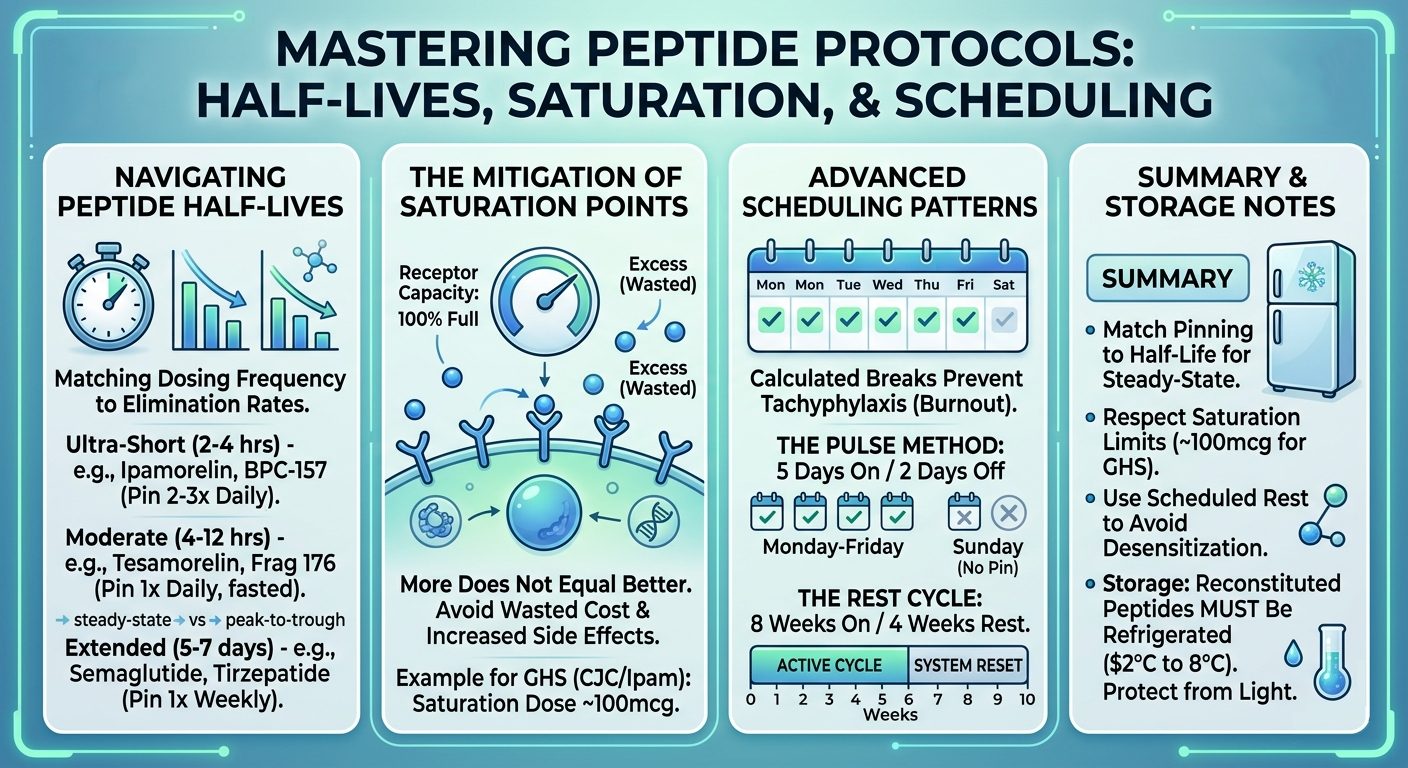
Peptides vary wildly here. Some vanish in minutes, while others linger for an entire week. If you inject a peptide with a 30-minute half-life just once a day, your body spends 23 hours completely baseline—wasting therapeutic momentum.
To maintain steady-state concentrations (keeping the healing or fat-burning signals constantly active), your dosing frequency must match the peptide’s metabolic profile.
| Metabolic Profile | Half-Life Range | Recommended Frequency | Common Examples | Clinical Rationale |
| Ultra-Short | 2 to 4 hours | 2–3x daily | BPC-157, Ipamorelin | Requires divided dosing to maintain consistent tissue repair and minimize sharp peak-to-trough crashes. |
| Moderate | 4 to 12 hours | 1x daily | Tesamorelin, Fragment 176-191 | Best timed around circadian rhythms (e.g., fasting windows or right before sleep). |
| Extended | 5 to 7 days | 1x weekly | Tirzepatide, Semaglutide | Engineered with fatty-acid chains to bind to albumin, slowly bleeding into the system over a week. |
Pillar 2: The Myth of “More” (Receptor Saturation)
In the world of biohacking, there is a dangerous temptation to assume that if 100mcg is good, 300mcg must be three times better. With peptides, biology draws a hard line called the saturation point.
Your cells have a finite number of receptors waiting to catch these peptide signals. Once every single receptor is occupied, the remaining peptide floating around has nowhere to go. It can’t trigger any extra benefits. Instead, your body simply breaks it down as waste, or worse, uses it to trigger unwanted side effects.
The Growth Hormone Secretagogue (GHS) Threshold
A classic example is the combination of CJC-1295 and Ipamorelin (used to stimulate natural growth hormone pulses).
The Saturation Standard: Clinical data shows that the saturation dose for GHS peptides is roughly 1mcg per kilogram of body weight, typically standardized to a flat 100mcg per injection.
Injecting 200mcg at once won’t give you a double-sized pulse of growth hormone. It will, however, dramatically increase your chances of experiencing cortisol spikes, intense hunger, fluid retention, or a morning headache.
Pillar 3: Advanced Scheduling Templates
Because your body is highly adaptive, keeping it on a rigid, unyielding protocol can lead to tachyphylaxis—a fancy clinical term for your receptors burning out and becoming desensitized to the signal.
To prevent this, advanced schedules rely on calculated breaks to let your endocrine system reset. Here are the three most common frameworks used in longevity medicine:
1. The 5-Days-On, 2-Days-Off Pulse
Best For: Growth Hormone Secretagogues (CJC-1295 / Ipamorelin).
The Strategy: You pin your dose for 5 consecutive days (e.g., Monday through Friday) and completely rest on the weekends.
Why it works: This mimics a natural physiological rhythm, preventing your pituitary gland from becoming sluggish or desensitized to the artificial pulse.
2. The On/Off Rest Cycle
• Best For: Tissue repair or fat-loss accelerators (BPC-157, TB-500, AOD-9604).
• The Strategy: 6 to 8 weeks of daily, steady-state administration, immediately followed by a strict 2 to 4 weeks of total rest.
• Why it works: Healing and lipolysis (fat-burning) pathways operate beautifully on concentrated bursts. Continuous, year-round use diminishes returns and delays your body’s baseline recovery.
3. The Step-Up Escalation
• Best For: Metabolic and GLP-1 peptides (Tirzepatide, Semaglutide).
• The Strategy: Forcing a strict titration schedule, such as starting at a minimal 2.5mg weekly for 4 weeks before stepping up to 5mg.
• Why it works: This isn’t about receptor burnout; it’s about gastrointestinal accommodation. Stepping up incrementally allows your body to build tolerance to delayed gastric emptying, mitigating nausea while keeping the metabolic benefits locked in.
Wrapping Up: Building Your Stack
When designing your personal protocol, map out your peptides by their half-lives first, audit your planned doses against known saturation limits, and build in clear systemic breaks.
In our next and final post of this series, we will tie all this together by looking at Synergy: How to safely stack multiple peptides in a single syringe without causing chemical degradation before covering how to inject peptides.
Drop your current protocol routines in the comments below, and let’s optimize them together!
Share The Beauty… Earn Rewards!
At PLEIJ Salon+Spa, we offer a simple and easy referral program to our existing clients (and even non-clients). When you refer a friend who is new to PLEIJ, we’ll give them a 20% OFF GIFT to use towards any service. To say thanks, we’ll give you a 10% OFF GIFT to use toward services or products!
Be sure to learn everything about this awesome program and even send out referrals.